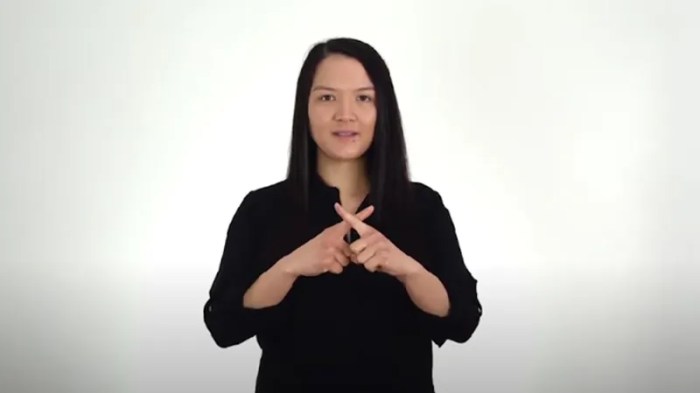
With “What is X in sign language?” as our guide, we embark on a journey to decipher the visual-manual language of the Deaf community. Sign language, a rich tapestry of handshapes, movements, and expressions, differs significantly from spoken languages. Understanding how to interpret “X” requires careful consideration of context, classifiers, and nuanced body language.
This exploration delves into the intricacies of sign language, examining how different sign languages express the same concept. We’ll cover the fundamental elements of sign language, including handshapes, locations, and movements, and demonstrate how these combine to create complete thoughts and sentences. We’ll also touch upon the importance of cultural sensitivity and appropriate communication etiquette when interacting with Deaf individuals.
Introduction to Sign Language

Sign language is a visual-manual communication method used by Deaf and hard-of-hearing communities worldwide. It employs hand gestures, facial expressions, and body movements to convey a wide range of information, including thoughts, emotions, and complex ideas. Sign languages are not simply variations of spoken languages; they are distinct linguistic systems with their own grammatical structures, vocabulary, and rules.
Sign language differs significantly from spoken languages in its modality, relying on visual-manual rather than auditory-vocal channels.Sign languages are diverse, with each having unique characteristics. Regional variations exist, and these variations, while maintaining the core structure, create nuanced differences in how signs are formed, and how grammatical concepts are expressed. These differences often reflect the linguistic and cultural heritage of the communities that use the sign language.
Understanding these variations is crucial for effective communication and appreciation of the richness and diversity within the Deaf community.
Types of Sign Languages and Regional Variations
Sign languages are not a monolithic entity. They are diverse, with various types existing across the globe. American Sign Language (ASL) and British Sign Language (BSL) are two of the most prominent examples, but many other sign languages exist, each with its own unique structure and vocabulary. These languages differ not only in the signs themselves but also in the grammatical structures, the way spatial relationships are conveyed, and the use of non-manual signals.
Common Sign Language Greetings
Several signs are used for greetings in various sign languages. A common ASL greeting is a slight bow of the head accompanied by a sign for “hello.” Similar salutations, while sharing the core concept, will differ slightly in execution in other sign languages. For example, the British Sign Language greeting might use different handshapes or hand placements to convey the same message.
Understanding these variations is essential for effective cross-cultural communication.
Historical Development of Sign Languages
The development of sign languages is a complex process, influenced by various factors, including the evolution of deaf communities, societal attitudes toward deafness, and interactions with spoken language communities. Historical records suggest that sign languages have existed for centuries, though their precise origins and development are often difficult to trace. Early sign languages were likely influenced by the spoken languages of the surrounding communities.
As Deaf communities grew and interacted more, these sign languages developed their own distinct grammatical structures.
Importance of Sign Language in Deaf Communities
Sign language plays a vital role in the lives of Deaf individuals. It is the primary means of communication, enabling them to connect with each other, share experiences, and build strong communities. Sign language allows Deaf individuals to express their thoughts, emotions, and identities freely. It also empowers them to participate fully in educational, social, and cultural activities.
Comparison of Sign Language Features
| Feature | American Sign Language (ASL) | British Sign Language (BSL) |
|---|---|---|
| Spatial Relationships | Emphasizes the use of space to indicate location, direction, and time | Emphasizes the use of space to indicate location, direction, and time, with variations in spatial representations |
| Grammar | Uses a different grammatical structure from spoken languages, including specific grammatical markers | Has a unique grammatical structure that differs from spoken languages and ASL |
| Vocabulary | Has a rich vocabulary, with specific signs for concepts and ideas | Has a rich vocabulary, with signs specific to the British cultural context |
| Non-Manual Signals | Includes a wide range of non-manual signals such as eye movements, head nods, and facial expressions to add nuances to the meaning of signs | Includes non-manual signals to clarify meaning, though there might be differences in the use of specific signals |
Understanding the Question “What is X in Sign Language?”

Deciphering the meaning of a sign in American Sign Language (ASL) or other sign languages goes beyond simply identifying the handshape. Understanding the nuanced context of a sign is crucial for accurate interpretation. This involves considering the grammatical structure of the language, the classifiers used, and the accompanying facial expressions and body language. This section will explore the multifaceted nature of sign language interpretation.Sign language is a visual-spatial language, fundamentally different from spoken languages.
Therefore, the meaning of a sign is often dependent on the context in which it is used, making it richer and more nuanced than a simple one-to-one correspondence with a word in a spoken language. This is why a single sign can represent various concepts, depending on the surrounding signs, the location of the hands, and the overall body language.
Interpreting the Term “X”, What is x in sign language
The term “X” in sign language, like in spoken language, can represent various parts of speech. It could be a noun (e.g., “object X”), a verb (e.g., “to X”), an adjective (e.g., “X-shaped”), or even a classifier. Crucially, the context surrounding the sign “X” is essential for determining its precise meaning. This context can include the signs before and after “X”, the location of the hands during the sign, and the use of classifiers.
Importance of Context in Sign Language Interpretation
Context plays a pivotal role in sign language interpretation. A single sign can take on multiple meanings depending on the specific context. For example, the sign for “book” can be used to represent different aspects of books, such as the physical object, the act of reading, or a reference to the content of a book. The specific nuance depends entirely on the surrounding signs and the overall context of the conversation.
The context helps to clarify the intended meaning, avoiding ambiguity and misunderstandings.
Examples of Context-Dependent Sign Meanings
The sign for “eat” (mouth opening motion with hand near mouth) can have several meanings depending on the context. If it is accompanied by a sign for “food”, the meaning is straightforward. However, if it is accompanied by a sign for “trouble” or “problem,” it might signify a struggle with eating. Understanding the context is crucial for accurate interpretation.
Role of Classifiers in Shaping Meaning
Classifiers in sign languages are crucial for representing the shape, size, and movement of objects and people. They are handshapes that accompany a sign to specify the attributes of the noun. For example, the sign for “throw” accompanied by a specific classifier will convey the shape of the object being thrown. The choice of classifier significantly influences the interpretation.
The classifier for a small, round object will differ from the classifier for a long, thin object.
Facial Expressions and Body Language in Sign Language
Facial expressions and body language are integral to conveying meaning in sign language. They provide additional context and nuance to the signs themselves. For example, a sign for “happy” accompanied by a wide smile and raised eyebrows conveys a stronger sense of joy than the same sign without those expressions. Facial expressions and body language contribute significantly to the overall message.
Comparison Across Different Sign Languages
While the core concepts are similar, different sign languages employ different grammatical structures and handshapes to convey the same ideas. For example, the sign for “table” in ASL may differ slightly from the sign for “table” in British Sign Language. Understanding these variations is essential for effective communication across different sign language communities.
Common Grammatical Structures in Sign Language
- Sign order is crucial. The sequence of signs often mirrors the word order in spoken languages. This structure influences the understanding of the sentence.
- The use of classifiers to represent objects and their characteristics. This is a crucial aspect of sign language grammar, helping to specify the attributes of nouns.
- Spatial relationships between signs are often used to indicate relationships between objects or ideas. The location of the hands in space conveys relationships.
| Grammatical Structure | Description |
|---|---|
| Subject-Verb-Object (SVO) | Common in many sign languages, mirroring spoken language structures. |
| Subject-Object-Verb (SOV) | Also present in some sign languages, exhibiting a different order of elements. |
| Verb-Subject-Object (VSO) | Less common, but seen in some sign languages. |
Sign Representation of Specific Nouns, Verbs, and Adjectives
Sign language, a visual-gestural language, relies on a complex system of handshapes, locations, and movements to convey meaning. This section delves into the specific representations of common nouns, verbs, and adjectives, demonstrating how these components combine to form complete sentences. Understanding these fundamental building blocks is crucial for effective communication and comprehension.
Common Nouns
Sign language utilizes various handshapes and locations to represent common nouns. The precise handshape, location, and movement significantly impact the meaning. For example, the sign for “dog” will differ from the sign for “cat,” reflecting the distinct visual characteristics of each animal.
- Dog: The sign for “dog” often involves a slightly cupped hand, resembling a dog’s head, held at chest height. A gentle, downward sweeping motion of the hand, as if gesturing toward the ground, completes the sign. This indicates the animal’s presence.
- Cat: The sign for “cat” typically uses a slightly curved handshape, resembling a cat’s ears, held near the chest. A quick, short flicking motion of the hand, mirroring the cat’s movement, adds to the sign’s meaning. This indicates the presence of the feline.
- House: The sign for “house” uses a flat hand, placed vertically in front of the body. A slight rotation of the hand around the vertical axis creates the sign for a house. This indicates a structure used as shelter.
Common Verbs
Verbs in sign language, like their spoken counterparts, express actions or states of being. Different verbs use distinct handshapes, locations, and movements. The combination of these elements is critical to accurately convey the intended action.
- Walk: The sign for “walk” often involves a slightly cupped hand, held near the waist. A rhythmic forward movement of the hand, mimicking the act of walking, is crucial to convey the verb.
- Eat: The sign for “eat” uses a slightly open hand, held near the mouth. A gentle, circular motion of the hand near the mouth conveys the act of eating.
- Sleep: The sign for “sleep” often involves a relaxed, flat hand, placed on the chest. A gentle, downward movement of the hand, as if the hand is falling on the chest, completes the sign. This indicates the action of sleeping.
Common Adjectives
Adjectives in sign language, like in spoken languages, describe nouns. Sign language uses a combination of handshapes, locations, and facial expressions to represent the descriptive nature of the adjectives.
- Big: The sign for “big” often involves the use of a wide, open handshape held outward from the body, gradually increasing the size of the hand to convey the adjective.
- Small: The sign for “small” typically involves a small, closed handshape held close to the body. The close proximity to the body suggests the diminutive nature of the adjective.
- Happy: The sign for “happy” usually involves a broad smile and a slight upward movement of the hands near the face. The facial expression and hand movement are crucial to conveying the adjective’s meaning.
Grammatical Order
The order of signs in sign language sentences often mirrors the order of words in spoken English sentences. The subject comes first, followed by the verb, and then the object. The order of signs directly impacts the meaning of the sentence.
Example Sentences
- The dog walks. (Dog sign, followed by walk sign)
- The cat eats. (Cat sign, followed by eat sign)
- The house is big. (House sign, followed by big sign)
Table of Common Signs
| Word | Sign Description (Handshape, Location, Movement) | Example Sentence |
|---|---|---|
| Dog | Slightly cupped hand, chest height, downward sweeping motion | Dog walks. |
| Cat | Slightly curved hand, chest height, quick flicking motion | Cat eats. |
| House | Flat hand, vertical in front of body, slight rotation | House is big. |
| Walk | Slightly cupped hand, waist height, rhythmic forward movement | Dog walks. |
| Eat | Slightly open hand, near mouth, gentle circular motion | Cat eats. |
| Sleep | Relaxed flat hand, on chest, gentle downward movement | I sleep. |
| Big | Wide open hand, outward from body, increasing size | House is big. |
| Small | Small closed hand, close to body | Cat is small. |
| Happy | Broad smile, slight upward hand movement near face | I am happy. |
Illustrative Examples of Signs
Sign language, while visually rich, requires careful consideration of handshapes, locations, and movements to convey precise meanings. Understanding these nuances is crucial for effective communication. This section will delve into specific examples, demonstrating how signs can be modified to express different shades of meaning and intensity. Furthermore, it will highlight the importance of proper execution in sign language.Sign variations are critical in conveying subtle differences in meaning or emphasis, akin to using tone of voice or inflection in spoken language.
For instance, a simple sign for “happy” can be modified by adding a slight upward movement to the hand to emphasize the feeling of extreme joy. This section will show how these modifications work and give practical examples.
Modifying Signs for Different Meanings
Variations in handshapes, locations, and movements significantly impact the meaning of a sign. For example, the sign for “small” can be contrasted with the sign for “big” by altering the size of the handshape or the extent of the movement. Likewise, the location of the sign on the body can convey different connotations. A sign for “near” might be made closer to the body than the sign for “far.”
Illustrative Scenarios and Sign Representations
Understanding sign language requires practice and immersion. The following examples demonstrate how signs can be used in practical situations, highlighting the nuances of expression.
- Scenario: Expressing happiness about a delicious meal.
Sign Description: The sign for “happy” (a hand moving in a circular motion near the face) can be made more intense by adding a wider, faster circular motion, accompanied by a facial expression reflecting great joy.
- Scenario: Asking if someone is hungry.
Sign Description: The sign for “hungry” (a hand moving to the stomach) can be accompanied by a questioning expression. The eyebrows might be raised, and the head tilted slightly.
- Scenario: Expressing disappointment about a missed opportunity.
Sign Description: The sign for “disappointed” (a downward motion of the hand) can be made slower and more emphatic, perhaps with a downward sigh in the expression, reflecting the depth of disappointment.
Common Phrases and Sentences
Fluency in sign language involves mastering the combination of signs to form phrases and sentences. The following examples demonstrate how common phrases are conveyed.
- Phrase: “I am happy to see you.”
Sign Description: The signs for “I,” “am,” “happy,” and “see” would be combined in a flowing sequence. The sign for “you” is directed towards the person being addressed.
- Phrase: “Where is the book?”
Sign Description: The sign for “where” (a hand moving in a circular motion in front of the body) is followed by the sign for “book,” and then a questioning expression.
- Phrase: “The cat is sleeping on the bed.”
Sign Description: The signs for “cat,” “is,” “sleeping,” “on,” “bed,” would be used in a sequential order, describing the action.
Nuances of Expression in Sign Language
Sign language is not just about the signs themselves, but also about the overall expression and context. Facial expressions, body language, and even pauses play crucial roles in conveying the intended meaning. The use of appropriate non-manual markers (e.g., eyebrows, head tilt, eye gaze) can significantly modify the meaning of the sign. This is often more subtle than the signs themselves.
Correct Handshape, Location, and Movement
Precise use of handshapes, locations, and movements is vital for accurate communication. Inaccurate execution can lead to misunderstandings. The table below illustrates the importance of proper execution in various scenarios.
| Scenario | Sign Description | Example Sentence |
|---|---|---|
| Expressing “small” | Small handshape, short movement | The car is small. |
| Expressing “big” | Large handshape, extended movement | The house is big. |
| Expressing “fast” | Rapid movement of the hands | The car is moving fast. |
Negating and Questioning Signs
Just like spoken language, sign language has ways to negate or question a statement. This can involve adding a specific sign, changing the handshape or movement of a sign, or using a non-manual marker. For example, to negate a sign, a shaking of the head can be used.
Common Misunderstandings and Cultural Considerations: What Is X In Sign Language
Learning to communicate effectively with Deaf individuals requires understanding their unique culture and avoiding common pitfalls. This section delves into common misconceptions about sign language, highlighting the importance of cultural sensitivity and proper communication etiquette. Respecting cultural differences and utilizing appropriate communication strategies fosters meaningful interactions and avoids potential misunderstandings.Misconceptions and cultural insensitivity can significantly hinder communication and create barriers between Deaf and hearing individuals.
This section aims to provide a comprehensive overview of these nuances, equipping readers with the knowledge and tools necessary for respectful and effective interactions.
Common Misconceptions about Sign Language
Sign language is not a universal language; different countries have distinct sign languages. Treating sign language as a single, homogenous system can lead to misinterpretations and communication breakdowns. Furthermore, sign language is a visual language with its own grammar and syntax, distinct from spoken languages. Misunderstanding this fundamental difference can result in frustrating and ineffective communication attempts.
It’s crucial to recognize that each sign language has its unique vocabulary and structure. For example, the sign for “hello” in American Sign Language (ASL) is quite different from the sign for “hello” in British Sign Language (BSL).
Importance of Respecting Cultural Differences in Deaf Communities
Deaf culture is a rich and diverse community with its own traditions, values, and social norms. Respecting Deaf individuals’ cultural preferences is paramount to effective communication. This involves recognizing the importance of Deaf community gatherings, events, and communication styles. Respecting Deaf culture means acknowledging their shared experiences, perspectives, and values, which fosters genuine connection and understanding. Learning about Deaf culture demonstrates respect and facilitates meaningful interactions.
Importance of Appropriate Communication Etiquette in Interactions with Deaf Individuals
Employing appropriate communication etiquette is essential for positive interactions with Deaf individuals. This includes using clear and concise language, speaking directly to the Deaf individual, and avoiding overly casual or patronizing language. It’s also crucial to be mindful of your body language and facial expressions, as these can significantly impact the interpretation of your message. Providing visual aids and ensuring sufficient lighting can enhance comprehension.
How to Communicate Effectively with Individuals Who are Deaf
Effective communication with Deaf individuals necessitates employing appropriate strategies. This involves utilizing clear and concise signs, providing visual aids when necessary, and ensuring good lighting conditions. Active listening and patience are essential to allow for the natural flow of communication. When in doubt, it’s always best to ask for clarification and confirm understanding.
Examples of Appropriate and Inappropriate Ways to Communicate with Deaf Individuals
| Appropriate Communication | Inappropriate Communication |
|---|---|
| Using clear and concise signs. | Using gestures or facial expressions that might be misinterpreted. |
| Speaking directly to the Deaf individual. | Speaking loudly or in a condescending tone. |
| Using visual aids and good lighting. | Assuming a shared understanding without confirmation. |
| Asking for clarification if needed. | Interrupting or rushing the conversation. |
| Showing patience and allowing time for responses. | Treating the Deaf individual as if they were not capable of understanding. |
“Effective communication with Deaf individuals requires a commitment to understanding their culture and employing appropriate strategies. This includes using clear and concise signs, providing visual aids when necessary, and ensuring good lighting conditions.”
Resources for Further Learning
Expanding your sign language knowledge requires consistent effort and access to quality resources. This section details various avenues for continued learning, including online platforms, local classes, and the crucial role of practicing with native sign language users. Finding reliable resources and dedicated practice are key components of mastering sign language.
Reputable Online Resources
Online resources offer a convenient and accessible way to supplement in-person learning. They provide diverse learning materials and often feature interactive exercises. These resources are valuable tools for reinforcing concepts and vocabulary learned in classes or during independent study.
- ASL University: This website offers a comprehensive collection of ASL lessons, videos, and practice activities. It is a user-friendly platform with structured courses, providing a substantial amount of material to help learners at different levels.
- Signing Savvy: This platform is well-regarded for its clear explanations and interactive exercises. It offers a variety of resources, including videos, quizzes, and flashcards. The interactive features encourage active learning and repetition.
- Lifeprint: Lifeprint provides a vast library of resources, from videos and lessons to dictionaries and cultural insights. Its extensive collection of materials allows learners to delve deeper into the language and its cultural context.
Finding Local Classes and Interpreters
Direct interaction with native sign language users is vital for improving fluency and comprehension. Locating local sign language classes or interpreters is a crucial step in this process.
Understanding the sign for “X” in sign language often involves exploring diverse handshapes and movements. This can be further explored in the context of a more complex concept, such as a “sign language monster” sign language monster. Learning how different signs are combined to create specific meanings can help clarify what “X” represents in a wider range of sign language contexts.
- Community Centers and Libraries: Many community centers and libraries offer sign language classes or workshops. These are often a good starting point for beginners.
- Local Colleges and Universities: Universities and colleges frequently provide sign language classes as part of their continuing education or language programs.
- Professional Organizations: Organizations specializing in interpreting or sign language education can provide listings of local interpreters or classes.
- Online Search Engines: Utilize online search engines (e.g., Google, Bing) to search for “sign language classes [your city/region]”. This will yield results based on your location.
Importance of Practice with Native Users
Practicing with native sign language users is crucial for developing fluency and proper communication skills. Native users can provide immediate feedback, correct misunderstandings, and offer insights into nuances and cultural contexts. This is especially important for developing conversational skills.
- Joining a Sign Language Community Group: Look for groups in your area or online communities focused on sign language. These provide a supportive environment for practice and interaction.
- Working with a Tutor or Interpreter: A qualified sign language tutor or interpreter can provide personalized feedback and guidance.
- Participating in Sign Language Events: Attend local events or gatherings where sign language is used to gain real-world experience.
Examples of Reputable Online Resources
The following table provides a concise overview of some reputable online resources for learning sign language, categorized by type, link, and a brief description.
| Resource Type | Link | Description |
|---|---|---|
| Website | [https://www.asluniversity.com/](https://www.asluniversity.com/) | Comprehensive ASL lessons, videos, and practice activities. Structured courses for different learning levels. |
| Website | [https://www.signingsavvy.com/](https://www.signingsavvy.com/) | Clear explanations, interactive exercises, videos, quizzes, and flashcards for a variety of sign language learning activities. |
| Website | [https://www.lifeprint.com/](https://www.lifeprint.com/) | Extensive library of ASL resources, including videos, lessons, dictionaries, and cultural insights. A wide range of learning materials for learners of all levels. |
Concluding Remarks
In conclusion, deciphering “What is X in sign language?” involves more than just memorizing signs. It necessitates a deep understanding of context, classifiers, and the intricate interplay of handshapes, movements, and expressions. By understanding these nuances, we can bridge the communication gap and foster greater understanding and appreciation for the rich linguistic tapestry of sign language. Further exploration into specific sign languages will reveal their unique characteristics and contribute to the broader conversation on inclusivity and effective communication.
FAQ Compilation
What are some common misconceptions about sign language?
A common misconception is that sign language is simply a pantomime of spoken language. Sign language is a complete language with its own grammar, syntax, and vocabulary, independent of spoken languages. Furthermore, different sign languages have distinct characteristics, making direct translation between them sometimes inaccurate.
How can I effectively communicate with someone who uses sign language?
Actively listen, use clear and concise language, and show patience and respect. If possible, learn a few basic signs and be open to using visual aids. Consider seeking assistance from a qualified interpreter if needed.
What resources are available for learning sign language?
Numerous online resources, such as YouTube channels and websites dedicated to sign language instruction, can provide introductory lessons and practice exercises. Local community centers and educational institutions often offer classes or workshops as well. Practice with native sign language users is crucial for effective learning.
How do classifiers impact the meaning of a sign?
Classifiers are used to describe the relationship between objects and actions. They specify the shape, size, and position of objects in a sentence, adding specificity and detail to the meaning of a sign. For example, different classifiers might be used to indicate a small dog versus a large dog.
