Rohingya language translator bridges the communication gap for a marginalized community. Understanding the intricacies of the Rohingya language, encompassing its diverse dialects and rich cultural context, is crucial for effective translation. This necessitates not only linguistic proficiency but also a deep comprehension of cultural nuances, ensuring accurate and sensitive communication. This exploration delves into the challenges and opportunities in this critical field.
The Rohingya language, with its unique linguistic characteristics and complex grammatical structures, presents significant translation hurdles. Accurate translation is vital for various sectors, including education, healthcare, and legal matters, ensuring equal access to resources and opportunities. This article investigates the current state of Rohingya language translation, examining the challenges, available resources, and the potential for future advancements.
Overview of Rohingya Language

The Rohingya language, spoken primarily by the Rohingya people, holds a significant place in the linguistic tapestry of Southeast Asia. Understanding its origins, classification, and unique characteristics is crucial for effective communication and cultural preservation. Its complex history and geographical distribution are intertwined with the socio-political context of the region.The Rohingya language, while facing challenges due to displacement and persecution, continues to be a vibrant expression of its speakers’ identity and cultural heritage.
Its unique features and distinct dialects contribute to its rich linguistic diversity.
A Rohingya language translator can bridge communication gaps, but their expertise extends beyond simply translating. For instance, a nuanced understanding of the nuances of the English language, when paired with the task of translating English to the Tongon language, translate english to tongan language , becomes crucial for effective communication. This highlights the multifaceted role of a Rohingya language translator in facilitating cross-cultural understanding.
Origin and Classification
The Rohingya language, despite facing various challenges, remains an integral part of the cultural identity of the Rohingya people. Its origins are rooted in the broader Indo-Aryan language family, with close linguistic ties to Bengali and other languages of the region. This connection underscores its historical and geographical context within South Asia. Scholars generally trace its development and evolution through a complex interplay of historical migration patterns and cultural exchange.
Geographical Distribution
The Rohingya language is primarily spoken in the Rakhine State of Myanmar, historically known as Arakan. However, significant Rohingya communities exist in neighboring countries like Bangladesh and Thailand, and even in diaspora communities worldwide. The language’s distribution is heavily influenced by historical migration patterns and the geopolitical landscape of the region. The historical and present-day political climate has significantly impacted the geographical distribution of the language.
Key Linguistic Features
The Rohingya language exhibits distinct linguistic characteristics that differentiate it from neighboring languages. Its grammar, vocabulary, and phonology reflect a unique linguistic heritage. The interaction of historical influences with the local environment has resulted in a rich set of features, often intertwined with the cultural and historical experiences of the speakers.
Dialects
Variations in the Rohingya language exist, with distinct dialects spoken across different geographical areas. These variations reflect the language’s historical and cultural evolution. Differences in pronunciation, vocabulary, and grammatical structures are common across these dialects, reflecting the diversity within the Rohingya community. These variations, while contributing to the richness of the language, can also pose challenges for speakers from different regions trying to communicate.
Summary of Linguistic Characteristics
| Characteristic | Description |
|---|---|
| Language Family | Indo-Aryan, closely related to Bengali and other languages of the region. |
| Writing System | The Rohingya language traditionally uses the Perso-Arabic script, adapted to represent the unique sounds of the language. This script has been adapted to represent the sounds of the Rohingya language. |
| Grammar | The grammatical structure of the Rohingya language is largely agglutinative, meaning that prefixes and suffixes are added to words to indicate grammatical relationships. |
Importance of Translation Services
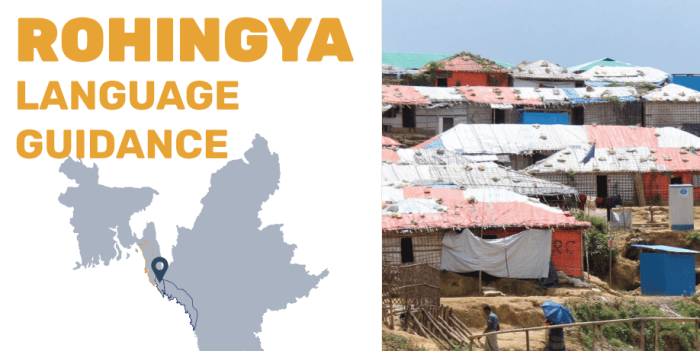
Accurate and accessible translation services are paramount for the Rohingya community, facilitating crucial communication and access to vital resources. The Rohingya, facing displacement and persecution, often find themselves marginalized due to language barriers, hindering their ability to navigate critical systems like education, healthcare, and legal processes. Effective translation bridges these gaps, empowering them to participate fully in society and achieve self-sufficiency.
Crucial Role in Education
Translation services are essential for Rohingya children’s educational success. Language barriers can prevent them from fully understanding classroom material, hindering their academic progress and limiting their future opportunities. Without proper translation of textbooks, lectures, and educational materials, students may struggle to grasp concepts and fall behind their peers. This can lead to lower educational attainment and diminished prospects for future employment.
Teachers, administrators, and educational institutions often benefit from translated materials to ensure inclusivity and provide a supportive learning environment for Rohingya students.
Impact on Healthcare Access
Accurate translation in healthcare settings is critical for the Rohingya community’s well-being. Medical professionals need accurate interpretations to understand patients’ symptoms, medical histories, and preferences. Language barriers can lead to misdiagnosis, inappropriate treatment, and ultimately, poorer health outcomes. Without effective translation, patients may not be able to communicate their needs or understand medical instructions, potentially resulting in preventable complications.
Effective translation ensures that Rohingya patients receive culturally sensitive and appropriate care.
Significance in Legal Matters
In legal contexts, translation services are vital for ensuring fairness and justice for the Rohingya population. Access to legal representation, court proceedings, and documentation is critical for upholding their rights. Language barriers can hinder their ability to understand legal procedures, potentially leading to unfair treatment and inadequate defense. Accurate translations of legal documents, witness testimonies, and court proceedings ensure that the Rohingya community can navigate the legal system effectively and advocate for their rights.
Table: Impact of Language Barriers on Different Sectors
| Sector | Impact of Language Barriers |
|---|---|
| Education | Reduced comprehension of course materials, hindering academic progress; limited access to educational resources and support services; decreased engagement and participation in the learning environment; potentially leading to lower educational attainment and diminished future opportunities. |
| Healthcare | Misinterpretation of symptoms and medical history; inappropriate treatment plans; lack of understanding of medication instructions; potential for misdiagnosis; poorer health outcomes; limited access to crucial medical information; reduced patient satisfaction and adherence to treatment. |
| Legal | Inability to understand legal procedures, documents, and court proceedings; limited access to legal representation and support; potential for unfair treatment and inadequate defense; difficulty in presenting evidence and advocating for rights; compromised justice system; increased risk of wrongful conviction or unjust outcomes. |
Challenges in Rohingya Language Translation: Rohingya Language Translator

Translating the Rohingya language presents unique and significant hurdles, extending beyond the linguistic complexities inherent in any language. These challenges are deeply intertwined with the socio-political context of the Rohingya people, impacting both the quality and accessibility of translation services. Overcoming these obstacles requires a multifaceted approach, acknowledging the cultural nuances and historical factors shaping the language.
Cultural Nuances and Idiomatic Expressions
The Rohingya language is rich with cultural nuances and idiomatic expressions, often rooted in the unique history, traditions, and social structures of the Rohingya people. Direct translations frequently fail to capture the intended meaning, as these expressions rely heavily on contextual understanding. For instance, a phrase seemingly simple in literal translation might carry a profound cultural connotation or even an implied insult within the Rohingya community.
These cultural subtleties require translators with deep understanding and empathy, going beyond mere linguistic proficiency. Furthermore, idioms often have multiple meanings depending on the specific context, which further complicates the translation process.
Dialect Variations
Significant dialect variations exist within the Rohingya language, especially considering the geographical dispersion of Rohingya communities. A translator working with one dialect may face difficulty understanding and accurately conveying meanings in another dialect. This dialectal diversity poses a challenge in developing standardized translation resources and materials. Translators need to be familiar with multiple dialects to ensure accurate representation across diverse Rohingya communities.
For example, a term for “thank you” in one dialect might be entirely different in another, highlighting the need for nuanced dialect-specific knowledge.
Lack of Resources and Qualified Translators
The Rohingya language faces a scarcity of readily available resources, including dictionaries, glossaries, and comprehensive linguistic studies. This paucity of resources hinders the development of robust translation tools and methodologies. Furthermore, the scarcity of qualified Rohingya translators, particularly those with formal training and linguistic expertise, creates a significant bottleneck in translation services. This scarcity is often exacerbated by the historical and ongoing displacement of the Rohingya population, which limits opportunities for language learning and professional development.
Potential Obstacles in Finding Qualified Rohingya Translators
Locating qualified Rohingya translators can be challenging due to various factors, including the political climate in the regions where many Rohingya reside. The precarious situation of the Rohingya people often limits access to education and formal language training, thus reducing the pool of qualified translators. In addition, the ongoing displacement and resettlement of Rohingya communities can further hinder the search for suitable translators, especially those with specific expertise in certain fields.
This challenge requires collaborative efforts to support Rohingya language education and translation training initiatives.
Key Challenges Faced by Rohingya Language Translators
| Challenge | Explanation |
|---|---|
| Cultural Nuances | Translators must possess deep cultural understanding to avoid misinterpretations and convey the intended meaning accurately. Failing to account for subtle cultural contexts can lead to serious miscommunications. |
| Dialect Variations | Significant variations in dialects make consistent and accurate translations across different regions difficult. The absence of standardized language norms adds to the complexity. |
| Lack of Resources | Limited availability of comprehensive linguistic resources, including dictionaries and specialized terminology, impedes the quality and efficiency of the translation process. |
Available Resources and Tools

The Rohingya language, facing significant challenges in accessibility and translation, necessitates a comprehensive exploration of available resources and tools. Understanding these tools is crucial for bridging communication gaps and fostering understanding. This section details existing resources, the role of technology, and the potential of machine translation to enhance translation services.Existing resources for Rohingya language translation are limited compared to widely spoken languages.
However, dedicated efforts are emerging, and these resources are vital for effective translation.
Existing Resources and Databases
Initial efforts to document and preserve the Rohingya language have resulted in the creation of online dictionaries and basic phrasebooks. These resources, while rudimentary, provide a starting point for translation and offer a glimpse into the language’s structure. The availability of these resources is uneven, and the quality and comprehensiveness vary considerably. Further research and development are necessary to improve the quality and expand the scope of these resources.
Role of Technology in Improving Translation Accessibility
Technology plays a crucial role in bridging communication gaps, particularly for minority languages. Translation software and online platforms are rapidly evolving, enabling more people to access and utilize translation services. For example, advancements in natural language processing (NLP) and machine learning (ML) have led to improved accuracy and speed in translation, which can help translate text from Rohingya to other languages and vice versa.
However, these technologies are still under development, especially for less-resourced languages.
Potential of Machine Translation
Machine translation (MT) holds immense potential for assisting Rohingya language translation. MT tools can translate text quickly and efficiently, which can be especially valuable for urgent communications and documentation. However, the accuracy of MT for complex or nuanced language structures is often limited, and human review is usually necessary for high-quality translations.
Utilizing Online Translation Tools, Rohingya language translator
Several online translation tools can assist with basic Rohingya language translation. These tools, though not perfect, provide a starting point for understanding the language. Users should, however, exercise caution and critically evaluate the output. Examples include Google Translate and DeepL, which offer basic translation capabilities. For example, if someone needs a basic greeting or a short phrase, these tools can be helpful for initial understanding.
However, for complex or important documents, professional human translation is still highly recommended.
Future of Rohingya Language Translation
The Rohingya language, facing significant challenges due to displacement and marginalization, requires robust translation services to ensure access to information and preserve its rich cultural heritage. Advancements in technology and increased global awareness of the Rohingya situation offer promising avenues for improving translation quality and accessibility in the years to come.The future of Rohingya language translation hinges on a multifaceted approach that combines technological innovation, dedicated research, and collaborative efforts from linguists, technologists, and the Rohingya community itself.
This will pave the way for more accurate, efficient, and culturally sensitive translations, empowering the Rohingya people and fostering greater understanding and inclusion.
Potential for Advanced Translation Technologies
The field of machine translation is rapidly evolving, with advancements in neural machine translation (NMT) models showing promising results for low-resource languages. Implementing these technologies in Rohingya translation could significantly improve speed and accessibility. However, the accuracy and cultural sensitivity of these models require careful consideration and refinement. This necessitates extensive training data tailored to the nuances of the Rohingya language and cultural context.
Need for Further Research and Development
Further research and development are crucial for enhancing the quality and accessibility of Rohingya language translation. This includes:
- Developing comprehensive Rohingya language corpora: Extensive, high-quality datasets of text and audio are essential for training robust machine translation models. These resources should be carefully compiled to accurately reflect the diverse dialects and regional variations within the Rohingya language.
- Improving the quality of existing linguistic resources: Existing dictionaries, grammars, and other linguistic resources need improvement to ensure accuracy and completeness. These resources need to be reviewed, updated, and expanded to address the specific grammatical structures and lexical nuances of the language.
- Exploring the use of multilingual models: Leveraging multilingual models that can translate between Rohingya and other languages could broaden access to information and facilitate communication in various contexts. For instance, if a Rohingya individual needed medical information, a multilingual translation system could offer access to information in multiple languages.
Innovations for Improving Translation Quality and Accessibility
Innovative approaches can significantly enhance translation quality and accessibility. These include:
- Utilizing community-based translation: Engaging Rohingya translators and language experts in the translation process will improve accuracy and cultural sensitivity. This could involve establishing partnerships with organizations that support community-based translation initiatives.
- Developing interactive translation tools: Interactive tools can improve accessibility by providing real-time translations and offering contextual explanations. These tools can incorporate cultural information and linguistic nuances to help users understand the nuances of the language.
- Creating accessible translation resources: Making translated materials readily available through various channels, including online platforms and mobile applications, will increase accessibility for Rohingya individuals. For example, distributing educational materials in Rohingya could improve literacy rates and educational opportunities for children.
Outcome Summary

In conclusion, providing accurate and accessible Rohingya language translation services is essential for fostering inclusivity and empowering the Rohingya community. Addressing the challenges in cultural nuances, dialect variations, and resource limitations requires a multi-faceted approach. The ongoing development of technology and resources, coupled with increased investment in qualified translators, promises a brighter future for effective communication within the Rohingya community.
Ultimately, this endeavor aims to dismantle communication barriers and foster greater understanding.
Detailed FAQs
What are some common challenges in translating Rohingya?
Significant challenges include the diversity of dialects, complex cultural nuances, and the scarcity of qualified Rohingya translators. Lack of readily available resources and standardized terminology further complicates the process.
How can technology assist in Rohingya language translation?
Technology, such as machine translation tools and online resources, can play a crucial role in increasing accessibility and expanding reach. However, the need for human intervention remains crucial for maintaining accuracy and cultural sensitivity.
What is the role of education in improving Rohingya language translation?
Investing in training programs for Rohingya translators and promoting language learning within the community are essential steps toward enhancing the quality and availability of translation services. This includes the development of educational materials and the support of language preservation initiatives.
How can language barriers affect healthcare for the Rohingya population?
Language barriers can impede effective communication between patients and healthcare providers, potentially leading to misdiagnosis, inappropriate treatment, and limited access to crucial medical information. This can have serious consequences for their health and well-being.
